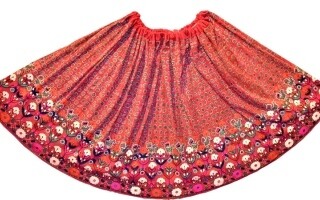
In the seventies of the last century, a student of the Nasrin al-Askari Medical University faced a situation that always changed her. After she posed a series of routine questions about the family history of a sick boy, she was met with anger. Taking off a different scarf and pointing to a complex embroidery, symbolizing everything—from women's society and social status to the number of her children—the mother said: "Most of the answers to your stupid questions are here."
This was al-Askari's first experience with the decorated fabrics of the Sindh province in southeastern Pakistan, with histories, autobiographies, and their creators, which sparked her lasting interest in unique fabrics, crafted distinctly by the Sindhi communities, and her desire to understand the histories embedded in the weave. Fifty years later, al-Askari collected around 1,000 such decorated fabrics, the largest collection of its kind, and made them the foundation for the first textile museum in Pakistan, which opened last December in Karachi together with her husband Hassan, a former curator of the British Museum.
Al-Askari noted that the textile traditions in Sindh are among the oldest in the world, tracing back to the times of the ancient civilization of Sindh in South Asia, and represent a unique synthesis of traditions encompassing not only Pakistan but also China, India, Iran, and Central Asia.
The fabrics collected by al-Askari are produced on a manual loom and dyed with natural dyes derived from roots and plants. She considers herself a representative of the rich traditions of Pakistani textiles and has achieved success at international art exhibitions, which showcased her collections.
She considered the possibility of donating her collection to the Victoria and Albert Museum but changed her mind. "We realized that if we donated the collection to a museum like (the Victoria and Albert), it would probably take a decade to be publicly displayed, possibly appearing once in ten years," al-Askari said.
Thus, she decided to establish her own museum in Sindh called "Haveli," which includes five halls demonstrating different types of embroidery from various corners of Pakistan, including traditional clothing that brides wear before their weddings, and wedding jewelry. Couples are expected to send a clear message upon the museum's opening, noting the inclusion of Indian minorities in the textile traditions of Sindh and emphasizing the importance of a humanitarian perspective on heritage.